

Where did all the teen summer jobs go?
Raymond James Chief Economist Eugenio J. Alemán discusses current economic conditions.
Ahead of next week’s May employment report, the summer jobs market is coming into focus as teenagers and students finish the school year. According to Challenger, Gray & Christmas, teen hiring from May through July is expected to total just 790,000 jobs this summer, down slightly from 801,000 last summer. If realized, that would be the weakest summer for teen hiring in the history of the Bureau of Labor Statistics data, which begins in 1948. Last summer was already the prior low; before that, the weakest readings were in 1949, in the post-war demobilization period, and in 2010, in the aftermath of the global financial crisis.
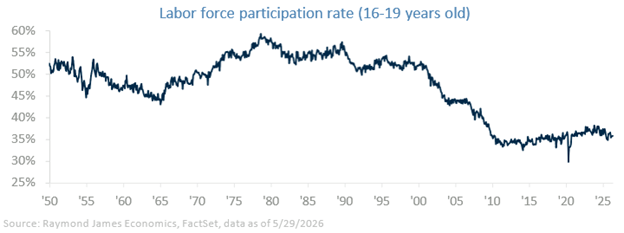
That historical context is important. Unlike 1949 or 2010, last year’s weak teen hiring did not coincide with a recession, and a recession is not our baseline for this year either. In our view, the weakness in teen summer employment looks less like a traditional recession signal and more like the result of structural changes in teen labor supply colliding with a more cautious hiring environment. Since the early 2000s, teen labor force participation has fallen significantly as shown in the chart below. Although it has recovered somewhat in recent years, it remains well below the levels that prevailed for much of the second half of the 20th century. A large part of that decline likely reflects changing priorities among students and families. Summer jobs now compete with AP coursework, test preparation, college admissions activities, club sports, camps, internships, volunteer work and other structured activities that are often viewed as part of the college and career-building process.
At the same time, summer employment remains an important steppingstone for younger and entry-level workers. These jobs provide early exposure to the workforce, helping teens develop soft skills such as communication, teamwork, responsibility and time management. They also give young workers a better understanding of workplace expectations, professional environments and the day-to-day realities of different industries and career paths. For many, a summer job serves as a first opportunity to build confidence, establish work habits, gain financial independence and develop practical experience that can benefit them later in their careers.
At the same time, demand for teen workers is also under pressure. The industries that typically hire teenagers during the summer like restaurants, retailers, amusement parks, camps, hotels and other leisure operators are still dealing with higher labor, input and fuel costs. For small businesses, that can mean waiting to see actual demand before adding seasonal workers. AI and automation may also be playing a small but growing role, especially in routine entry-level tasks such as ordering, scheduling, inventory checks and basic customer service.
Importantly, weak teen hiring should not be interpreted as a clear sign that the consumer is rolling over. The consumer backdrop still looks bifurcated rather than recessionary. Higher-income households remain relatively resilient, while lower-income and more price-sensitive consumers are showing more strain. That split has also been visible in recent earnings reports, where higher-end companies have generally fared better than lower-tier, more price-sensitive businesses. Similarly, high-frequency services data do not point to a uniform pullback: air travel has softened because of higher airfare prices, but restaurant demand has been growing double digits.
From a broader labor-market perspective, teen employment is too small to move the headline numbers very much. As of April, employment among 16-to-19-year-olds was about 5.4 million, or roughly 3.3% of total employment. The teen labor force was about 6.3 million, or roughly 3.7% of the total labor force.
That means the unemployment rate math is very small. Holding the labor force constant, it would take roughly 170,000 additional unemployed workers to lift the unemployment rate by 0.1 percentage point. Challenger’s forecast implies teen summer job gains fall by only 11,000 versus last summer, from 801,000 to 790,000. Even if every one of those missing jobs translated into an actively unemployed teen, the mechanical impact on the unemployment rate would be only about 0.006 percentage point, far below anything that would move the headline number.
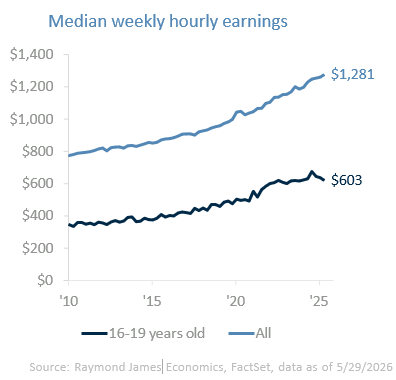
The income effect should also be limited. In the first quarter of 2026, full-time wage and salary workers ages 16 to 19 earned median weekly pay of $603, compared with $1,235 for all full-time wage and salary workers. In other words, teen earnings are less than half the overall median, further limiting the aggregate spending impact from softer teen hiring.
Bottom line
Teen summer jobs still matter a lot to the individuals who get them. They provide income, independence, and early workplace skills that can have long-term benefits. But from a macro perspective, this year’s projected weakness in teen hiring looks more like a structural and sector-specific pressure point than a recession warning or a meaningful driver of the overall employment report.
Economic and market conditions are subject to change.
Opinions are those of Investment Strategy and not necessarily those of Raymond James and are subject to change without notice. The information has been obtained from sources considered to be reliable, but we do not guarantee that the foregoing material is accurate or complete. There is no assurance any of the trends mentioned will continue or forecasts will occur. Past performance may not be indicative of future results.
